Cease fire? Not yet
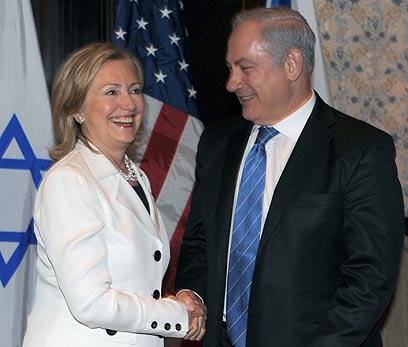
All evening, Hamas’ Ayman Taha has been telling anyone who will listen that a cease fire would be announced at 9:00 pm and would take effect at midnight. But at 10:00 pm, Israel radio reported that an agreement had yet to be reached and that Prime Minister Netanyahu was meeting with Secretary of State Clinton at 11:00 pm. And CNN is now reporting that the Egyptian government says that it has no intention of announcing a cease fire on Tuesday night.
Here’s Prime Minister Netanyahu meeting with German Foreign Minister Guido Westerweille.
Lets go to the videotape:
It sure doesn’t sound like a cease fire is in the immediate offing.
By the way, I read somewhere today that we have 30,000 troops on the Gaza border. To put this in perspective, Operation Cast Lead involved 10,000 troops, and the government has the authority to call up 70,000 or 75,000 (I’ve seen two different versions) reserves.
If Israel does go into Gaza, as has been noted before, it will look more like Operation Defensive Shield (the 2002 operation in which Israel retook control of the ‘Palestinian’ populated cities of Judea and Samaria) than like Operation Cast Lead. That means that if the IDF goes into Gaza, they plan to stay there for a while.
More and more people are acknowledging that leaving Gaza in 2005 was a mistake. One who came out quite prominently today is Bret Stephens, the former JPost editor who now writes for the Wall Street Journal (full article for those who do not have access to the Journal here). Stephens doesn’t think a cease fire is a great idea either. He’s right – this time.
My error was to confuse a good argument with good policy; to suppose that mere self-justification is a form of strategic prudence. It isn’t. Israel is obviously within its rights to defend itself now against a swarm of rockets and mortars from Gaza. But if it had maintained a military presence in the Strip, it would not now be living under this massive barrage.
Or, to put it another way: The diplomatic and public-relations benefit Israel derives from being able to defend itself from across a “border” and without having to get into an argument about settlements isn’t worth the price Israelis have had to pay in lives and terror.
…
In 2004, the last full year in which Israel had a security presence in Gaza, Gazans fired 281 rockets into Israel. By 2006 that figure had risen to 1,777. The Strip became a terrorist bazaar, home not only to Hamas but also Islamic Jihad and Ansar al-Sunna, an al Qaeda affiliate.
In late 2008, Israel finally tried to put a stop to attacks from Gaza with Operation Cast Lead. The limited action—Israeli troops didn’t go into heavily populated areas and refrained from targeting Hamas’s senior leadership—was met with broad condemnation, including a U.N. report (since recanted by its lead author) accusing Israel of possible “crimes against humanity.”
Nor did the reality of post-occupation Gaza do much to dent the appetite of the Obama administration for yet another effort to broker Israeli-Palestinian peace. That included a settlement freeze in the West Bank (observed by the government of Benjamin Netanyahu, to zero benefit) and calls by President Obama for Israel to withdraw to its 1967 lines “with mutually agreed swaps.”
In 2009, Hillary Clinton disavowed the Bush-Sharon exchange of letters, saying they “did not become part of the official position of the United States government.” Even today, the Obama administration considers Gaza to be “occupied” territory, a position disavowed even by Hamas.
Put simply, Israel’s withdrawal from Gaza yielded less security, greater diplomatic isolation, and a Palestinian regime even more radical and emboldened than it had been before. As strategic failures go, it was nearly perfect.
Now Israel may be on the cusp of purchasing yet another long-term strategic failure for the sake of a short-term tactical success. The Israeli government wants to bomb Hamas into a cease-fire—hopefully lasting, probably orchestrated in Cairo. That way Israel gets the quiet it seeks, especially on the eve of elections in January, and the Egyptians get the responsibility for holding the leash on Hamas.
That is largely how it played out during Cast Lead. But as one leading Israeli political figure told me in January 2009, just as the last cease-fire had been declared, “Notwithstanding the blows to the Hamas, it’s still in Gaza, it’s still ruling Gaza, and the Philadelphi corridor [which runs along Gaza’s border with Egypt] is still porous, and . . . Hamas can smuggle new rockets unless [the corridor] is closed, to fire at Israel in the future.”
That leading political figure was Benjamin Netanyahu, just before he returned to office as prime minister. He might now consider taking his own advice. Israel can afford to watch only so many reruns of this same, sordid show.
UPDATE 11:01 PM
Israel Radio reports that there will be no announcement of a cease fire before Wednesday.
The IDF just destroyed tunnels that are used to transport gas and oil. They went up in flames.
Categories: Israel in the News
 U.S. Bombs Iran’s Nuclear Sites in Devastating Strikes
  The Hamas War for the Total Destruction of Israel – What’s Next?
  AOC Slams Biden for Supporting Israel and the ‘Squad’ Accuses Israel of Terrorism While Supporting Actual Terrorists
  Are The Attacks on Trump And Netanyahu Connected?
  I Am Not Ashamed Of The Gospel Of Christ!
Here’s a link, sounds like this was a joke, literally. Read to the bottom. http://www.israelnewsagency.com/iranisraelpeacetreatyaprilfoolsahmadinejadperesolmertobamajerusalemholocaust48010409.html I’m sure they won’t tell how long, they know, Israel and Christians are watching. There are some that say that the treaty signed with Israel in 2009 or 2010 with Obama is a peace treaty. I’m not so sure.
LikeLike
Israel has a right to protect themselves. Lord be with them! Amen!
LikeLike