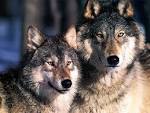
Lonely wolf? Wolves howl when they miss their friends

Wolves are skilled and ferocious hunters, but when it it comes to relationships, they’re real softies. When a playmate or partner leaves the pack, the wolves that are left behind will howl and howl and howl.
In a new study, researchers report that wolves will give their leaders and their closest allies a longer and stronger serenade if they leave. Those howls could be sonic breadcrumbs, meant to help a lone wolf find its way back to the pack. They could also be a long-distance message that simply says: “I miss you.”
“What exactly their motivation is, we will never know,” said Friederike Range, an animal behavior researcher at the University of Veterinary Medicine in Vienna and one of the authors of the study in Current Biology. But “there is an emotional response in there, for sure,” she told NBC News.
How much howling?
Range and her colleagues have been studying the group dynamics of timber wolves for years. In the newly published study, they observed how nine wolves from two packs living at Austria’s Wolf Science Center changed their howling, depending on which member of the pack was absent from the group.
The researchers took each member of the pack away from the rest for a walk, and counted the howls from the remaining members for 20 minutes.
The howling would begin as soon as the departing wolf went out of sight. Wolves are social animals with a strict hierarchy. So if the wolf was a leader, more howls were recorded. And if the departing wolf was friendly with another member of the pack, its pack buddy sang a lengthy song.
The calls are similar to “children calling for their parents when the parents leave,” David Mech, an adjunct professor at the University of Minnesota who has been studying wolves since the late 1950s, explained in an email to NBC News. “To me it is communication.”
Socially savvy
Dogs, the cuddlier relatives of the wolves, also howl. But wolves are more socially savvy, and their howling serves more strategic functions.
Mech, who was not involved with the new study, once observed howling behavior in 15 wild wolves that were separated during a hunt. He described the phenomenon in his 1966 book “The Wolves of Isle Royale.”
“After howling, the pack was then able to assemble again,” he explained. Mack said the newly published study provides “experimental evidence” supporting his view that the wolves’ howls helped them regroup.
Sometimes, wolves howl when they are stressed. Not these wolves. Range’s colleague, Francesco Mazzini, tested the saliva of the howlers for cortisol, a hormone that’s abundant in stressed-out animals. He found a slight increase in cortisol levels when a leader left, but no increase when the wanderer was a “preferred partner.”
Wandering wolves who are leaders will often call back to their pack, but Range’s wards didn’t. While they were out and about, they ignored their packmates and just enjoyed the walk, she said.
More about animal communication:
- The whale that talked like a human
- How animals laugh
- Wolves behind the howls can be ID’d by computer program
Categories: Human interest
 The Un-American Leftist NFL, Bad Bunny, Perversion, Unity, and Love
  The 4th of July, Remembrance, and God
  Free Will Verses Election: Solved
  Celebrating Mom
  I Am Not Ashamed Of The Gospel Of Christ!
Catherine…………Thank You so much for the reblog!It’s very much appreciated. God Bless You.
Julia
LikeLike
Love this atricle! And yyour right, animals definately have feelings too!
LikeLike
Reblogged this on Shania's song..
LikeLike
Animals are a gift from God we should cherish them, they have far more intelligence than some humans!
LikeLike
Yes, Anne I agree totally with you. 🙂
LikeLike
Artbella………I hear you,when my one cat passed away my other one cried night and day so I got another cat and they are best friends and the one that was left never cried again.People don’t give animals any credit,yet they will support wrongdoers in a second……kinda shows who is smarter at times.God Bless You.
Julia
LikeLike
I wholeheartedly agree! If any of our family members is absent from home, one of our dogs will sit on the couch and wait (where he can see the street and the driveway) and just kind of sulk until this person returns. Then he is back to being his happy self.
Animals are connected to the nature much stronger than we are. Living our comfortable lives we have forgotten what really means and how to survive out there (in case we needed it). God is out there in the nature, in the whisper of the wind, in the sound of the rain, but we have forgotten how to listen.
“Be still, and know that I am God…” (Psalm 46:10)
Also, what you’ve talked about the other day Julia:
“But ask now the beasts, and they shall teach thee; and the fowls of the air, and they shall tell thee:
Or speak to the earth, and it shall teach thee: and the fishes of the sea shall declare unto thee.
Who knoweth not in all these that the hand of the Lord hath wrought this?
In whose hand is the soul of every living thing, and the breath of all mankind.
(Job 12:7-10)
LikeLike