By Before It’s News
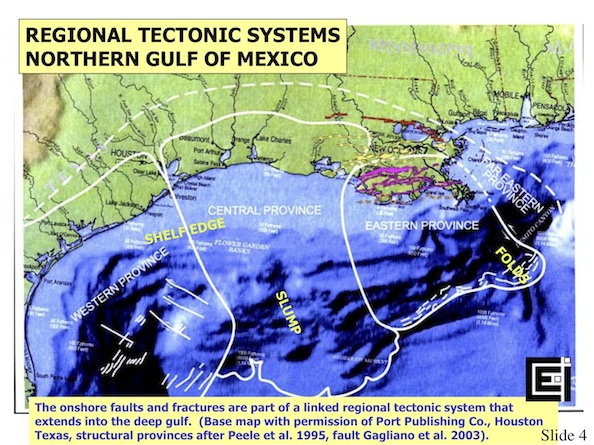
Louisiana’s onshore faults and fractures link to Gulf of Mexico where methane gas has been leaking since April 2010 when BP wrecked the Macondo well, MC 252. Presently, Apache Corporation is trying to stop methane that is migrating from its well. (Photo Credit: Dr. Sherwood Gagliano et. al)

Proven and suspected faults in South Louisiana and of its coast in the Gulf of Mexico were mapped by Baton Rouge based Coastal Environments, Inc. president Sherwood Gagliano, PhD in 2005 and presented in a research report and slide presentation. (Photo Credit: Dr. Sherwood Gagliano et. al)
Explosive methane gas migrating along fault lines from the Gulf of Mexico to Lake Peigneur and Bayou Corne sinkhole disaster salt domes is not only possible, but also has been a known oil and gas industry risk since 2005, according to a civil engineering expert who spoke with human rights reporter Deborah Dupré Monday.
“The fault lines are planes of weakness and the methane leakages represent the faults,” Sherwood Gagliano, Ph.D. said on the telephone Monday.
This “shows that scientists and officials are not as in-the-dark about the events,” Save Lake Peigneur member Glo Conlin wrote in an email Monday.
Apache Corporation is trying to kill highly pressured migrating gas in the Gulf of Mexico’s Main Pass Block 295 50 miles east of Venice and in BP’s wrecked MC-252 Macondo well region.
Wednesday, about 50 miles west, sheriff asked motorists to stay clear of Lake Peigneur due to two days of vigorous bubbling/foaming where an arsenic plume is.
Fifty miles further north, there’s enough methane bubbling in over 40 sites in the bayou “sinkhole” 2-mile salt dome area “to do very serious damage to anything on the surface if it’s not controlled,” according to chief geologist on that disaster case.
These events are linked, and maybe in more ways than one, according to civil engineer and president of Baton Rouge-based Coastal Environments, Inc. Dr. Sherwood Gagliano, who has spent years researching fault lines in south Louisiana and the Gulf of Mexico.
Down under dome quake danger
“Salt domes are there because of faults,” . “They don’t just happen on their own.”
In fact, fault movement is an underrated natural hazard in South Louisiana, according to Gagliano. Differential movement between low-density salt and adjacent sedimentary deposits might have a wedging effect on faults, initiating brine water and gas moving up fault zones, he reports.
Aside from gas migrating from Apache’s well in the Gulf off Louisiana’s coast, at least two regional methane gas leakage events now occur near the Gulf, at Lake Peigneur and Bayou Corne, are linked: Each is manmade due to salt dome mining, rather than solely natural events.
“Those dome leakages with methane escaping are more due to hot water being pumped into them,” explained Gagliano.
The primary method of extracting underground salt is pumping hot water into the underground salt domes. “Today, all brine operations inject steam or hot water into dry salt beds.” (Michigan State University, Salt mining: mining part)
“We have over 100 of those facilities on faults in South Louisiana and Texas, Gagliano said. “They all need to be reevaluated.”
Sixty-one of those salt dome facilities correlate with known subsurface faults, according to Gagliano’s 2005 report.
Louisiana Department of Natural Resources (LDNR) recently issued an order for all of the state’s 34 salt dome operators to show how close their oil and gas industry storage caverns are to outer edges of the domes, and prove that caverns nearest dome edges are structurally sound. This was an admission of the state previously failing to ensure such safety measures.
In 2005, Gagliano led a comprehensive study of suspected relationships between geological faults and subsidence in Southeastern Louisiana, reporting findings in Effects of Earthquakes, Fault Movements, and Subsidence on the South Louisiana Landscape.
“When oil, gas and produced water are removed, localized subsidence and fault movement may occur,” he then reported. “Geological fault movement, compaction and fluid withdrawal are inter-related processes contributing to subsidence.
“Differential movement between the low-density salt and adjacent sedimentary deposits may have a wedging effect on the faults, initiating brine water and gas movement up fault zones,” Gagliano reported. “The water and gas in turn may lubricate the fault plane surfaces and cause instability along fault segments.”
While finding that faulting poses a natural hazard in Louisiana, according to Gagliano, pumping water into the domes to dissolve salt for brine allows methane to migrate along faults and veins.
Gagliano concluded his 2005 report saying, “Until recently, the relationship between geological faulting and coastal land loss had been largely neglected by researchers, and by the coastal restoration community.”
Dangerous South Louisiana gas migration
Only 90 miles east of bubbling Lake Piegneur and about 140 miles from gas-bubbling Bayou Corne sinkhole area, Apache’s rig evacuated two weeks ago after an underground blowout. This event reportedly involves migrating natural gas only, and they are trying to “kill” it from a platform.
“In other instances of this happening, the upward-shooting gas also involves oil, both escaping into surrounding bedrock and ultimately reaching the water surface,” On Wings of Care Dr. Bonnie Shumakerreported after her Gulf flyover last week.
As gas continues migrating, the large surface sheen Shumaker had been seeing in MC-252 (Macondo well) area “seems to have gone.”
About 50 miles northwest of Apache’s incident, South Louisiana’s Vermilion and Iberia Parish sheriff’s offices and state officials responded to Wednesday morning calls by residents seeing Lake Peigneur bubbling two days running.
About 50 miles north of Lake Peigneur, 20 more methane gas bubbling sites were recorded by officials involved in Louisiana’s “sinkhole” disaster area.
Peigneur bubbles
Iberia Parish Sheriff’s Office asked motorists to stay clear of Lake Peigneur area until the Louisiana’s Department of Natural resources (DNR) and Department of Environmental Quality assess the bubbling.
Nara Crowley, Save Lake Peigneur Inc. president, said last week marked the first time bubbling continued into a second day, although odd bubbling has occurred since 2005.
At a public hearing later on Wednesday night, locals also raised concerns about the amount of water from their sole water supply, Chicot Aquifer, that would be needed to create new caverns in the salt dome in the lake, and about an arsenic plume there.
Residents surrounding Lake Peigneur have long questioned the bubbling and many have opposed expanding the salt dome storage caverns in their lake.
Residents had gathered Wednesday night at a public hearing in New Iberia about the state permitting AGL Resources to expand its salt dome under Lake Peigneur with more caverns.
Jim Brugh, regional manager of Louisiana Water Company, LAWCO, said the company knows an arsenic plume is within the aquifer east of the company’s wells in New Iberia Parish.
“The company only recently developed a new well field west of the plume that it estimated the arsenic wouldn’t reach for 50 years,” the Daily Iberian reported. With accelerated draw down from AGL resources, however, Brugh said Wednesday night that they could not be so sure.
“We’re very, very concerned the plume will contaminate the wells,” Brugh said.
Article Continues, Continue Reading On Before It’s News
Categories: Earth quakes news/data, news
 Volcanic Eruption Causes Devastating Tsunami Catching All Off Guard
  In That Day
  Signs
Signs  REPOST: WOE to the COASTAL CITIES !
  I Am Not Ashamed Of The Gospel Of Christ!
I have read so many articles or reviews about the blogger lovers however this post is actually a good post, keep it
up.
LikeLike